среда, 20 декабря 2023 г.


Analytical chemistry

Most of the materials that occur on Earth, such as woodcoalminerals, or air, are mixtures of many different and distinct chemical substances. Each pure chemical substance (e.g., oxygen, iron, or water) has a characteristic set of properties that gives it its chemical identity. Iron, for example, is a common silver-white metal that melts at 1,535° C, is very malleable, and readily combines with oxygen to form the common substances hematite and magnetite. The detection of iron in a mixture of metals, or in a compound such as magnetite, is a branch of analytical chemistry called qualitative analysis. Measurement of the actual amount of a certain substance in a compound or mixture is termed quantitative analysis. Quantitative analytic measurement has determined, for instance, that iron makes up 72.3 percent, by mass, of magnetite, the mineral commonly seen as black sand along beaches and stream banks. Over the years, chemists have discovered chemical reactions that indicate the presence of such elemental substances by the production of easily visible and identifiable products. Iron can be detected by chemical means if it is present in a sample to an amount of 1 part per million or greater. Some very simple qualitative tests reveal the presence of specific chemical elements in even smaller amounts. The yellow colour imparted to a flame by sodium is visible if the sample being ignited has as little as one-billionth of a gram of sodium. Such analytic tests have allowed chemists to identify the types and amounts of impurities in various substances and to determine the properties of very pure materials. Substances used in common laboratory experiments generally have impurity levels of less than 0.1 percent. For special applications, one can purchase chemicals that have impurities totaling less than 0.001 percent. The identification of pure substances and the analysis of chemical mixtures enable all other chemical disciplines to flourish.

The importance of analytical chemistry has never been greater than it is today. The demand in modern societies for a variety of safe foods, affordable consumer goods, abundant energy, and labour-saving technologies places a great burden on the environment. All chemical manufacturing produces waste products in addition to the desired substances, and waste disposal has not always been carried out carefully. Disruption of the environment has occurred since the dawn of civilization, and pollution problems have increased with the growth of global population. The techniques of analytical chemistry are relied on heavily to maintain a benign environment. The undesirable substances in water, air, soil, and food must be identified, their point of origin fixed, and safe, economical methods for their removal or neutralization developed. Once the amount of a pollutant deemed to be hazardous has been assessed, it becomes important to detect harmful substances at concentrations well below the danger level. Analytical chemists seek to develop increasingly accurate and sensitive techniques and instruments.

Sophisticated analytic instruments, often coupled with computers, have improved the accuracy with which chemists can identify substances and have lowered detection limits. An analytic technique in general use is gas chromatography, which separates the different components of a gaseous mixture by passing the mixture through a long, narrow column of absorbent but porous material. The different gases interact differently with this absorbent material and pass through the column at different rates. As the separate gases flow out of the column, they can be passed into another analytic instrument called a mass spectrometer, which separates substances according to the mass of their constituent ions. A combined gas chromatograph–mass spectrometer can rapidly identify the individual components of a chemical mixture whose concentrations may be no greater than a few parts per billion. Similar or even greater sensitivities can be obtained under favourable conditions using techniques such as atomic absorption, polarography, and neutron activation. The rate of instrumental innovation is such that analytic instruments often become obsolete within 10 years of their introduction. Newer instruments are more accurate and faster and are employed widely in the areas of environmental and medicinal chemistry.

пятница, 15 декабря 2023 г.

Organic chemistry


Organic chemistry


Organic compounds are based on the chemistry of carbon. Carbon is unique in the variety and extent of structures that can result from the three-dimensional connections of its atoms. The process of photosynthesis converts carbon dioxide and water to oxygen and compounds known as carbohydrates. Both cellulose, the substance that gives structural rigidity to plants, and starch, the energy storage product of plants, are polymeric carbohydrates. Simple carbohydrates produced by photosynthesis form the raw material for the myriad organic compounds found in the plant and animal kingdoms. When combined with variable amounts of hydrogen, oxygen, nitrogensulfur, phosphorus, and other elements, the structural possibilities of carbon compounds become limitless, and their number far exceeds the total of all nonorganic compounds. A major focus of organic chemistry is the isolation, purification, and structural study of these naturally occurring substances.

Many natural products are simple molecules. Examples include formic acid (HCO2H) in ants, ethyl alcohol (C2H5OH) in fermenting fruit, and oxalic acid (C2H2O4) in rhubarb leaves. Other natural products, such as penicillin, vitamin B12, proteins, and nucleic acids, are exceedingly complex. The isolation of pure natural products from their host organism is made difficult by the low concentrations in which they may be present. Once they are isolated in pure form, however, modern instrumental techniques can reveal structural details for amounts weighing as little as one-millionth of a gram. The correlation of the physical and chemical properties of compounds with their structural features is the domain of physical organic chemistry. Once the properties endowed upon a substance by specific structural units termed functional groups are known, it becomes possible to design novel molecules that may exhibit desired properties.

 The preparation, under controlled laboratory conditions, of specific compounds is known as synthetic chemistry. Some products are easier to synthesize than to collect and purify from their natural sources. Tons of vitamin C, for example, are synthesized annually. Many synthetic substances have novel properties that make them especially useful. Plastics are a prime example, as are many drugs and agricultural chemicals. A continuing challenge for synthetic chemists is the structural complexity of most organic substances. To synthesize a desired substance, the atoms must be pieced together in the correct order and with the proper three-dimensional relationships. Just as a given pile of lumber and bricks can be assembled in many ways to build houses of several different designs, so too can a fixed number of atoms be connected together in various ways to give different molecules. Only one structural arrangement out of the many possibilities will be identical with a naturally occurring molecule. The antibiotic erythromycin, for example, contains 37 carbon, 67 hydrogen, and 13 oxygen atoms, along with one nitrogen atom. Even when joined together in the proper order, these 118 atoms can give rise to 262,144 different structures, only one of which has the characteristics of natural erythromycin. The great abundance of organic compounds, their fundamental role in the chemistry of life, and their structural diversity have made their study especially challenging and exciting. Organic chemistry is the largest area of specialization among the various fields of chemistry.

пятница, 17 ноября 2023 г.

What is aluminium?

 What is aluminium?

Aluminium is a silvery-white metal, the 13 element in the periodic table. One surprising fact about aluminium is that it's the most widespread metal on Earth, making up more than 8% of the Earth's core mass. It's also the third most common chemical element on our planet after oxygen and silicon.

At the same time, because it easily binds with other elements, pure aluminium does not occur in nature. This is the reason that people learned about it relatively recently. Formally aluminium was produced for the first time in 1824 and it took people another fifty years to learn to produce it on an industrial scale.

The most common form of aluminium found in nature is aluminium sulphates. These are minerals that combine two sulphuric acids: one based on an alkaline metal (lithium, sodium, potassium rubidium or caesium) and one based on a metal from the third group of the periodic table, primarily aluminium.

Aluminium sulphates are used to this day to clean water, for cooking, in medicine, in cosmetology, in the chemical industry and in other sectors. By the way, aluminium got its name from aluminium sulphates which in Latin were called alumen.

Today we know about almost 300 various aluminium compounds and minerals containing aluminium, from feldspar, a key source mineral on Earth, to ruby, sapphire and emerald, which are far less common.

But regardless of how common aluminium may be, it may have remained hidden forever if it hadn't been for electricity. The discovery of aluminium was made possible when scientists were able to use electricity to break down chemical compounds into their elements. In the 19 century the Danish physicist Christian Oersted used electrolysis to obtain aluminium. Electrolysis or electrolytic reduction is the process that is used to produce aluminium today as well.

Another rather common mineral, bauxite, is used today as the primary raw material in aluminium production. Bauxite is a clay mineral comprising various modifications of aluminium hydroxide mixed with iron, silicon, titanium, sulphur, gallium, chromium, vanadium oxides, as well as sulphuric calcium, iron and magnesium carbonates. In other words, your typical bauxite contains almost half the periodic table. By the way, because of the texture of bauxite about a hundred years ago aluminium was often referred to rather poetically as silver obtained from clay. On the average 4-5 tonnes of bauxite are needed to produce 1 tonne of aluminium.

In the first stage of aluminium production bauxite is processed into alumina, or aluminium oxide Al2O3. Alumina looks like white powder and it is then processed into aluminium at aluminium smelters using electrolytic reduction.

Aluminium production requires huge amounts of electricity, about 15 MWH per tonne of output. That's approximately as much as a 100-apartment block consumes in a month. So the best site for an aluminium smelter is next to a powerful, preferably renewable, energy source. Hydroelectric power plants are the best option as they are the most powerful 'green' energy sources available today.

Aluminium offers a rare combination of valuable properties. It is one of the lightest metals in the world: it's almost three times lighter than iron but it's also very strong, extremely flexible and corrosion resistant because its surface is always covered in an extremely thin and yet very strong layer of oxide film. It doesn't magnetise, it's a great electricity conductor and forms alloys with practically all other metals.

Since aluminium easily forms compounds with other chemical elements, a huge variety of aluminium alloys have been developed. Even a very small amount of admixtures can drastically change the properties of the metal, making it possible to use it in new areas. For example, in ordinary life you can find aluminium mixed with silicon and magnesium literally on the road, i.e. in the aluminium alloy wheels, in the engines, chassis and other parts of modern automobiles. As for aluminium zinc alloy, chances are you might be holding it in your hands right now as it's this alloy that's widely used in the production of mobile phones and tablet PCs. In the meantime, scientists keep developing new aluminium alloys.

The modern construction, automotive, aviation, energy, food and other industries would be impossible without aluminium. In addition, aluminium has become a symbol of progress: all cutting edge devices and vehicles are made from aluminium. 

What Is the Most Conductive Element?

 What Is the Most Conductive Element?

Conductivity is a material’s ability to transmit energy. Because there are different forms of energy, there are different types of conductivity, including electrical, thermal, and acoustic conductivity. Silver is the most conductive element, in terms of electrical conductivity. Carbon in the form of diamond is the best thermal conductor (silver is the best metal). After silver, copper is the next best conductor, followed by gold. In general, metals are the best thermal and electrical conductors.

Why Is Silver the Best Conductor?

The reason silver is the best electrical conductor is because its electrons are freer to move than those of other elements. This has to do with silver’s crystal structure and electron configuration. Although silver is the best electrical conductor, it readily tarnishes and loses conductivity, plus it is more expensive than copper. Gold is used when corrosion resistance is important.

Here is a table of the electrical conductivity of the ten most conductive elements. All of these elements are metals. Many alloys are also conductive, including carbon steel, stainless steel, brass, bronze, Galinstan, and Manganin. Nonmetals are electrical insulators, with a few exceptions.

Electrical Conductivity of the Elements

Most conductive elements:

Silver

Copper

Gold

Aluminum

Calcium

Tungsten

Zinc

Cobalt

Nickel

Ruthenium

Thermal Conductivity of the Elements

Here is a table of thermal conductivity of the elements. Most tables only list metals, because metals in general conduct heat better than nonmetals. Diamond (a nonmetal) is an exception.

Diamond (carbon)

Silver

Copper

Gold

Aluminum

Beryllium

Calcium

Tungsten

Magnesium

Rhodium

Silicon

вторник, 17 октября 2023 г.

Fluorine

 Fluorine

The element fluorine

<---Oxygen       Neon--->
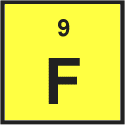
  • Symbol: F
  • Atomic Number: 9
  • Atomic Weight: 18.998
  • Classification: Halogen
  • Phase at Room Temperature: Gas
  • Density: 1.696 g/L @ 0°C
  • Melting Point: -219.62°C, -363.32°F
  • Boiling Point: -188.12°C, -306.62°F
  • Discovered by: Henri Moissan in 1886


Fluorine is the first element in the group of halogens which occupies the 17th column of the periodic table. Fluorine atoms have 9 electrons and 9 protons. It is a fairly rare element in the universe, but is the thirteenth most common element in the Earth's crust.

Characteristics and Properties

Fluorine's most notable characteristic is that it is the most reactive of all the elements. This makes it dangerous and difficult to handle. It will react with nearly every other element. It is also the most electronegative of the elements, meaning that it attracts electrons towards itself.

In standard conditions fluorine forms a gas made up of two fluorine atoms called a diatomic gas. It is pale greenish-yellow in color with a pungent odor.

Fluorine is toxic for humans and very corrosive. Many of the reactions with fluorine are sudden and explosive. Fluorine will burn all sorts of compounds and elements including water, copper, gold, and steel.

Where is fluorine found on Earth?

Because it is so reactive, fluorine does not occur as a free element in nature. It is readily found in minerals in the Earth's crust including fluorspar, fluorapatite, and cryolite. The main source of commercial fluorine is fluorspar (which is also called fluorite). The majority of the world's fluorspar is supplied by China and Mexico.

How is fluorine used today?

Fluorine is rarely used in its pure form, but many compounds of fluorine are used by industry.

One of the most popular applications of fluorine is for refrigerant gases. For many years Chlorofluorocarbons (CFCs) were used for freezers and air conditioners. Today they have been banned because they damage the ozone layer. Many of the replacement gases still contain fluorine, however.

Another application is fluoride. Fluoride is a reduced form of fluorine when bonded to another element. Fluoride is helpful in preventing tooth decay and is used in tap water and toothpaste.

Other applications that use fluorine include high temperature plastics such as Teflon, the smelting of iron and metal production, pharmaceuticals, etching glass, and in processing nuclear fuel.

How was it discovered?

Although other chemists had suspected the presence of an unknown element in the compound fluoric acid, it was French chemist Henri Moissan who first successfully isolated the element in 1886.

Where did fluorine get its name?

The name fluorine is derived from the mineral fluorite which comes from the Latin word "fluere" meaning "to flow." The name was suggested by English chemist Sir Humphry Davy.

Isotopes

Fluorine has one stable isotope, fluorine-19. It is the only form that fluorine occurs in naturally.

Interesting Facts about Fluorine
  • Hydrofluoric acid is extremely dangerous and can be fatal.
  • Henri Moissan was awarded the Nobel Prize in 1906 for his discovery.
  • It is found in the gemstone topaz.
  • CFCs were once used as propellant in aerosol spray cans.
  • The bond formed between carbon and fluorine to make fluorocarbons is the strongest bond in organic chemistry and is very stable.
  • Cesium is sometimes called fluorine's opposite element because it is the least electronegative element.

Chlorine

 Chlorine

The element chlorine

<---Sulfur       Argon--->
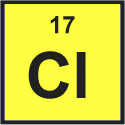
  • Symbol: Cl
  • Atomic Number: 17
  • Atomic Weight: 35.45
  • Classification: Halogen
  • Phase at Room Temperature: Gas
  • Density: 3.2 g/L @ 0°C
  • Melting Point: -101.5°C, -150.7°F
  • Boiling Point: -34.04°C, -29.27°F
  • Discovered by: Carl Wilhelm Scheele produced the gas in 1774, but it was Sir Humphry Davy who first called it an element and named it chlorine in 1810
Chlorine is the second element in the seventeenth column of the periodic table. It is classified as a member of the halogen group. It has 17 electrons and 17 protons with 7 valence electrons in the outer shell. It is about the twentieth most abundant element in the Earth's crust.

Characteristics and Properties

Under standard conditions chlorine is a gas that forms diatomic molecules. This means that two chlorine atoms join together to form Cl2. Chlorine gas is greenish yellow, has a very strong odor (it smells like bleach), and is poisonous to humans. High concentrations of chlorine gas can be fatal.

Chlorine is very reactive and, as a result, is not found in its free form in nature, but only in compounds with other elements. It will dissolve in water, but will also react with water as it dissolves. Chlorine will react with all the other elements except the noble gases.

Most common chlorine compounds are called chlorides, but it also forms compounds with oxygen called chlorine oxides.

Where is chlorine found on Earth?

Chlorine can be found in abundance in both the Earth's crust and in ocean water. In the ocean, chlorine is found as part of the compound sodium chloride (NaCl), also known as table salt. In the Earth's crust, the most common minerals containing chlorine include halite (NaCl), carnallite, and sylvite (KCl).

How is chlorine used today?

Chlorine is one of the most important chemicals used by industry. Tens of billions of pounds of chlorine are produced each year in the United States alone for use in industrial applications. It is used in making a variety of products including insecticides, pharmaceuticals, cleaning products, textiles, and plastics.

You have probably heard people mention that chlorine is used in pools. Chlorine is used in pools to keep it clean and safe by killing bacteria, germs, and algae. It is also used in drinking water to kill bacteria so we don't get sick when we drink it. Because it kills germs, chlorine is also used in disinfectants and is the basis for most bleaches.

Chlorine is needed for the survival of animal life in the form of table salt (NaCl). Our body's use it to help us digest food, move our muscles, and fight off germs.

How was it discovered?

Chlorine gas was first produced by Swedish chemist Carl Wilhelm Scheele in 1774. However, for many years scientists thought that the gas contained oxygen. It was English chemist Sir Humphry Davy who proved that it was a unique element in 1810. He also gave the element its name.

Where did chlorine get its name?

Chlorine gets its name from the Greek word "chloros", which means "yellow-green."

Isotopes

Chlorine has two stable isotopes: Cl-35 and Cl-37. Chlorine found in nature is a mixture of these two isotopes.

Interesting Facts about Chlorine
  • Chlorine gas was used by the Germans in WWI to poison the Allied soldiers.
  • Around 1.9% of the ocean's mass is composed of chlorine atoms.
  • It has a high density for a gas of 3.21 grams per liter (air is around 1.29 grams per liter).
  • Chlorine is used to make chlorofluorocarbons or CFCs. CFCs were once widely used in air conditioners and spray cans. Unfortunately, they contributed to destroying the ozone layer and have been mostly banned.
  • Most chlorine gas for industry is produced by using electrolysis on water that contains dissolved sodium chloride (salt water).

Iodine

 Iodine

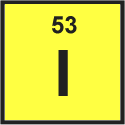
  • Symbol: I
  • Atomic Number: 53
  • Atomic Weight: 126.904
  • Classification: Halogen
  • Phase at Room Temperature: Solid
  • Density: 4.933 grams per cm cubed
  • Melting Point: 113.7°C, 236.66°F
  • Boiling Point: 184.3°C, 363.7°F
  • Discovered by: Bernard Courtois in 1811
Iodine is the fourth element in the seventeenth column of the periodic table. It is classified as a halogen and a non-metal. Iodine atoms have 53 electrons and 53 protons with 7 valence electrons in the outer shell.

Characteristics and Properties

Under standard conditions iodine is a dark blue-black solid. Iodine crystals can sublimate directly from a solid to a gas. As a gas, iodine is a purple vapor.

Iodine is a fairly active element, but is somewhat less active than the other halogens above it in the periodic table which include bromine, chlorine, and fluorine. Iodine can form compounds with many elements. Some of its most common compounds are formed with sodium and potassium.

Pure iodine can be dangerous to handle causing the skin to burn and damage to the eyes.

Where is it found on Earth?

Iodine is fairly rare, but is found in both the Earth's crust and in ocean water. There is actually a higher concentration of iodine in the ocean than in the Earth's crust. Some ocean plants such as seaweed have a high concentration of iodine. It is also found in underground brines near oil and natural gas reserves.

How is iodine used today?

Iodine has a number of uses. It is used in sanitation systems and as an antiseptic to kill germs and bacteria. It is also used in its radioactive form to enable doctors to diagnose medical issues and diseases.

Other applications include animal feed, cloud seeding, dyes, and photography.

Iodine is also an essential element for life. It plays an important role in the thyroid gland that controls the body's growth rate. Too little iodine can cause a person to have stunted growth and slower cognitive development (less intelligent). To make sure that people get enough iodine, it is often added to salt in what is called iodized salt.

How was it discovered?

Iodine was first discovered and isolated by French chemist Bernard Courtois in 1811. Courtois stumbled across iodine when running experiments on seaweed. It was French chemist Gay-Lussac who first named iodine as a new element and suggested the name.

Where did iodine get its name?

Iodine gets its name from the Greek word "iodes" which means "violet."

Isotopes

Iodine has one stable isotope that occurs naturally, iodine-127.

Interesting Facts about Iodine
  • Many people get the iodine they need in their diets from eating seaweed.
  • It is the heaviest element that is essential for human life and health.
  • Foods rich in iodine include fish, diary products (milk, cheese, yogurt), some fruits and vegetables, and iodized salt.
  • Pregnant women need more iodine than the average person. They can get this through dietary supplements.
  • Too much iodine is harmful and can make a person very sick. Never take iodine unless instructed by a doctor.