пятница, 28 октября 2016 г.

Periodic Table and the Elements

Now we're getting to the heart and soul of the way the Universe works. You know that a generic atom has some protons and neutrons in the nucleus and some electrons zipping around in orbitals. When those pieces start combining in specific numbers, you can build atoms with recognizable traits. If you have eight protons, neutrons and electrons, you will have an oxygen (O) atom. If you have seven protons, neutrons, and electrons, you will have a nitrogen(N) atom. The atoms for each element are unique, even though they are all made of similar subatomic parts. 

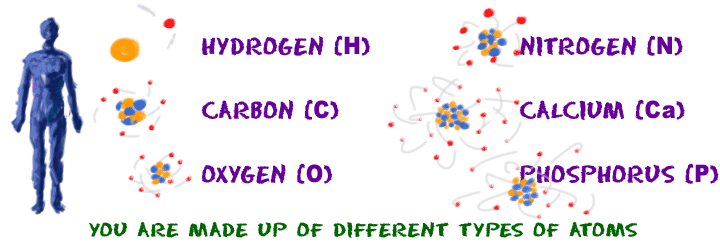
Remember that 'atom' is the general term. Everything is made of atoms. The term 'element' is used to describe atoms with specific characteristics. There are almost 120 known elements. For example, you are made up of billions of billions of atoms but you probably won't find more than 40 elements (types of atoms) in your body. Chemists have learned that over 95% of your body is made up of hydrogen (H), carbon (C), nitrogen, oxygen, phosphorus (P), and calcium (Ca). 
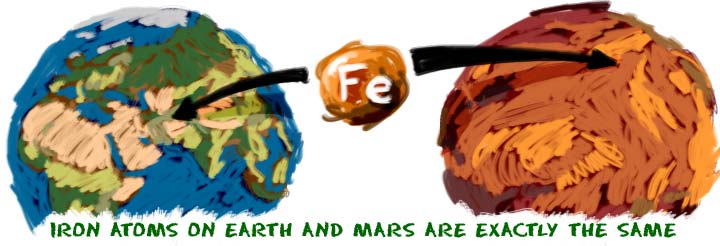


As far as we know, there are a limited number of basic elements. Up to this point in time, we have discovered or created about 120. Scientists just confirmed the creation of element 117 in 2014. While there are more elements to discover, the basic elements remain the same. Iron (Fe) atoms found on Earth are identical to iron atoms found on meteorites. The iron atoms in the red soil of Mars are also the same. 

With the tools you learn here, you can explore and understand the Universe. You will never stop discovering new reactions and compounds, but the elements will be the same. 

The List of Elements


Since the launch of the site, we've been asked, "Why start with 18?" The rules for the first eighteen elements are very straightforward: 

(1) Electrons fit nicely into three orbitals. Remember that the orbitals are the places you will generally find the electrons as they spin around the nucleus. 
(2) These eighteen elements make up most of the matter in the Universe.
(3) It's a lot easier to remember facts about 18 elements than over 100 elements. 
Element 1: Hydrogen
Element 2: Helium
Element 3: Lithium
Element 4: Beryllium
Element 5: Boron
Element 6: Carbon
Element 7: Nitrogen
Element 8: Oxygen
Element 9: Fluorine
Element 10: Neon
Element 11: Sodium
Element 12: Magnesium
Element 13: Aluminum
Element 14: Silicon
Element 15: Phosphorus
Element 16: Sulfur
Element 17: Chlorine
Element 18: Argon

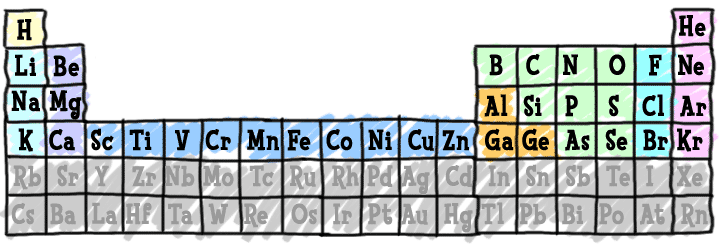
As we move past the first eighteen elements, you can start to learn about transition elements in the fourth period (row) of the periodic table. The transition metals have electron configurations that are a little different from the first eighteen. Make sure you understand the basics of electron orbitals before you move on to this row. 
Element 19: Potassium
Element 20: Calcium
Element 21: Scandium
Element 22: Titanium
Element 23: Vanadium
Element 24: Chromium
Element 25: Manganese
Element 26: Iron
Element 27: Cobalt
Element 28: Nickel
Element 29: Copper
Element 30: Zinc
Element 31: Gallium
Element 32: Germanium
Element 33: Arsenic
Element 34: Selenium
Element 35: Bromine
Element 36: Krypton

Oxford English Daily Conversation Episode 2


Oxford English Daily Conversation Episode 1


Atoms Around Us

Atoms are building blocks. If you want to create a language, you'll need an alphabet. If you want to build molecules, you will need atoms of different elements. Elements are the alphabet in the language of molecules. Each element is a little bit different from the rest. 

Why are we talking about elements when this is the section on atoms? Atoms are the general term used to describe pieces of matter. You have billions of billions of atoms in your body. However, you may only find about 40 elements. You will find billions of hydrogen (H) atoms, billions of oxygen(O) atoms, and a bunch of others. All of the atoms are made of the same basic pieces, but they are organized in different ways to make unique elements. 


Let's work with that idea for a bit. If you read a book, you will find words on each page. Letters make up those words. In English, we only have twenty-six letters, but we can make thousands of words. In chemistry, you are working with almost 120 elements. When you combine them, you can make millions of different molecules. 

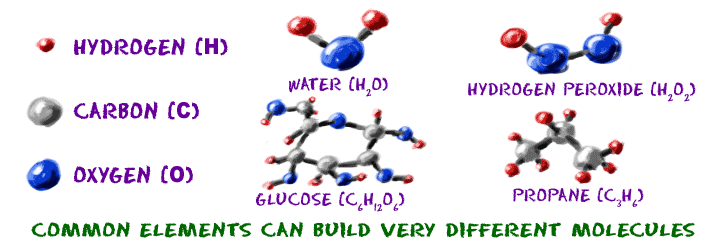
Molecules are groups of atoms bonded together in the same way that words are groups of letters. An "A" will always be an "A" no matter what word it is in. A sodium (Na) atom will always be a sodium atom no matter what compound it is in. While the atoms have different masses and organization for each element, they are all built with the same parts. Electrons, protons, and neutrons make the Universe the way it is. 

If you want to do a little more thinking, imagine the smallest particles of matter. Super-tiny subatomic particles are used to create the parts of atoms. Protons, neutrons, and electrons can then organize to form atoms. Atoms are then used to create the molecules around us. As we just learned, there are almost 120 elements that can be found in the molecules we know. Smaller molecules can work together and build macromolecules. It just goes on. Everything you see or imagine is built from something else. 

You could start really small...
- Particles of matter
  - Atoms
    - Molecules
      - Macromolecules
        - Cell organelles
          - Cells
            - Tissues
              - Organs
                - Systems
                  - Organisms
                    - Populations
                      - Ecosystems
                        - Biomes
                          - Planets
                            - Systems with Stars
                              - Galaxies
                                - The Universe
                                  ...And finish really big. 

Wow! All of that is possible because of atoms.

четверг, 29 сентября 2016 г.

Different styles to say 'I Love You' - Spoken English Lesson

Liquid Basics

Liquid Basics

Liquids are the second state of matter we will talk about. Solids are objects you can hold and maintain their shape.
Gases are floating around you or trapped in bubbles. Liquids are found between the solid and gas states. Examples of liquids at room temperature include water (H2O), blood, and even honey. If you have different types of molecules dissolved in a liquid, it is called a solution. Honey is a solution of sugar, water, and other molecules. 

Liquids fill the shape of any container they are in. If you pour water in a cup, it will fill up the bottom of the cup first and then fill the rest. If you freeze that cup of water, the ice will be in the shape of the cup. 

The top of a liquid will usually have a flat surface. That flat surface is the result of gravity pulling on the liquid molecules. Let’s go back to the cup for a moment. If you put an ice cube (solid) into the cup, it will sit there and not change shape. As the cube warms and melts, the liquid water will fill the bottom of the cup and have a flat surface on top. 

Pushing on a Liquid

Effort required to compress liquidsAnother trait of liquids is that they are difficult to compress. When you compress something, you take a certain amount of material and force it into a smaller space or volume. You force the atoms closer together. Most solids are very difficult to compress while gases are easier. You can find compressed gases in SCUBA air tanks. Liquids are in the middle, but tend to be difficult to compress because the molecules are already close together. You probably can’t compress a liquid with your hands. It takes a lot of force. 

Many shock absorbers found in cars and trucks have compressed liquids, such as oils, in sealed tubes. Without shocks, there would be a very rough ride for the driver and a lot of stress on the structure of the car. The shocks counter the extremes of the up and down motion by acting as a dampening device

Molecules Sticking Together

Intermolecular forces are found in all substances. Some of the forces bring molecules together while others push them apart. Solids are locked together and you have to force them apart. Gases bounce everywhere and spread out. Many liquids want to stick together because of cohesive (sticky) forces that pull the molecules together. 

When you place a drop of water on a piece of glass, you will see it stay together as a drop. Cohesive forces keep the drop from spreading out. Cohesive forces also keep water molecules together if there is a drip on your faucet. The water sticks together until it is too heavy. It drips when the weight of the water drop overcomes the cohesive forces holding it all together. 

Evaporation occurs when individual liquid molecules gain enough energy to escape the system and become a gas. The extra energy allows individual molecules to overcome the intermolecular forces within the liquid. 

Solid Basics

Solid Basics

What is one physical characteristic of a solid? Solids can be hard like a rock, soft like fur, a big rock like an asteroid, or small rocks like grains of sand. The key is that solids hold their shape and they don't flow like aliquid. A rock will always look like a rock unless something happens to it. The same goes for a diamond. Solids can hold their shape because their molecules are tightly packed together. 

You might ask, "Is baby power a solid? It's soft and powdery." Baby power is also a solid. It's just a ground down piece of talc. Even when you grind a solid into powder, you will see tiny pieces of that solid under a microscope. Liquids will flow and fill up any shape of container. Solids like to hold their shape. 

In the same way that a large solid holds its shape, the atoms inside of a solid are not allowed to move around too much.Atoms and molecules in liquids and gasesare bouncing and floating around, free to move where they want. The molecules in a solid are stuck in a specific structure or arrangement of atoms. The atoms still vibrate and the electrons fly around in their orbitals, but the entire atom will not change its position. 


Solid Mixtures

Solids can be made of many things. They can have pure elements or a variety of compounds inside. When you have a solid with more than one type of compound, it is called a mixture. Most rocks are mixtures of many different compounds. Concrete is a good example of a man-made solid mixture. 


Granite is a mixture you might find when you hike around a national park. Granite is made of little pieces of quartz, mica, and other particles. Because all of the little pieces are spread through the rock in an uneven way, scientists call it a heterogeneous mixture. Heterogeneous mixtures have different concentrations of compounds in different areas of the mixture. For example, there might be a lot of quartz and very little feldspar in one part of the granite, but only a few inches away those amounts might flip. 

Crystals

On the other end of the spectrum is something called a crystal. A crystal is a form of solid where the atoms are arranged is a very specific order. Crystals are often pure substances and not all substances can form crystals because it is a very delicate process. The atoms are arranged in a regular repeating pattern called a crystal lattice. Table salt (NaCl) is a great example of a crystal you can find around your house. The sodium (Na) and chlorine (Cl) atoms arrange themselves in a specific pattern to form the cubic salt crystals.