воскресенье, 30 сентября 2018 г.

Glossary and Terms
Glossary and Terms
Acid - An acid is a compound with a pH of less than 7 that forms hydrogen ions when dissolved in water. Acids react when coming into contact with bases and some metals to form salts.
Alkali metals - The alkali metals are the elements in the first column of the periodic table with the exception of hydrogen.
Alkaline earth metals - The alkaline earth metals are the elements in the second column of the periodic table.
Alloy - An alloy is a metallic mixture of two or more elements. Examples of alloys include brass, bronze, and steel.
Allotropes - Allotropes are different forms in which the same element can exist. For example, the element carbon can take the form of the allotrope graphite or the allotrope diamond.
Aqueous solution - Any solution where water is the solvent.
Atom - The atom is a basic unit of matter and the smallest unit of an element. It consists of a nucleus which is surrounded by a cloud of electrons.
Base - A base is a substance with a pH higher than seven. Bases are defined as donating a pair of valence electrons.
Biochemistry - The study of chemical processes as they relate to living organisms.
Bond - An attraction between atoms that forms chemical substances.
Bunsen burner - A piece of chemistry lab equipment that produces a flame used for lab experiments.
Carbon cycle - A method by which carbon is constantly moved throughout the biosphere.
Catalyst - A substance that speeds up the rate of a chemical reaction. The catalyst is not consumed in the reaction.
Chemical reaction - A process where a set of substances undergo a chemical change to form a different substance.
Compound - A chemical compound is a pure substance made up of two or more elements.
Conductor - A conductor is a material that allows the flow of energy such as heat or electricity.
Covalent bond - Covalent bonding occurs between atoms that share a pair of electrons in order to gain full outer shells.
Density - Density is the mass per unit volume of a substance.
Distillation - The process of separating mixtures by boiling a liquid and then recovering the cooled gas.
Ductile - The ability of a material to be stretched into a long wire.
Electrolysis - A process used to drive a chemical reaction by using an electrical current. It is often used to separate elements.
Electron - A particle of an atom that orbits the atom's nucleus and carries a negative charge.
Element - A pure chemical substance that is made up of one type of atom. Each atom in an element is defined by an atomic number which is the number of protons in the nucleus.
Ion - An atom or molecule which has a negative or positive charge because the number of electrons does not equal the number of protons.
Ionic bond - Ionic bonding is when an electron is traded between atoms in order to have full outer shells.
Isotopes - Isotopes are atoms from the same element that have different numbers of neutrons.
Malleable - A substance is said to be malleable if it can be pounded into a thin sheet.
Metal - A substance that is a good conductor of heat and electricity. They are generally malleable, ductile, and shiny.
Mixture - A combination of two or more substances that are not chemically combined.
Molecule - A molecule is formed when two or more atoms are joined together by a chemical bond.
Neutron - A particle in the nucleus of an atom that has no electric charge.
Noble gases - A family of elements that makes up column 18 of the periodic table. They are very stable due to their full outer electron shells.
Nucleus - The central core of an atom containing the protons and neutrons.
Oxidation - The name for the process when oxygen combines with another element to form a compound.
Periodic table - A table of the chemical elements arranged by atomic number.
PH scale - The pH measures the activity of the hydrogen ion in substances. If a substance has a pH less than 7 it is said to be acidic. If its pH is greater than 7 then it said to be basic or alkaline.
Proton - A particle within the nucleus of an atom that holds a positive charge.
Reaction - The process that occurs when two or more chemical substances are combined to form another chemical substance.
Salts - Salts are chemical compounds that are formed by the reaction of an acid and a base.
Solution - A homogeneous mixture where one substance called the solute is fully dissolved into another substance called the solvent. For example, a solution is formed when salt dissolves into water to make the solution salt water.
Valence electron - An electron in an atom that can participate in a chemical bond.
Alkali metals - The alkali metals are the elements in the first column of the periodic table with the exception of hydrogen.
Alkaline earth metals - The alkaline earth metals are the elements in the second column of the periodic table.
Alloy - An alloy is a metallic mixture of two or more elements. Examples of alloys include brass, bronze, and steel.
Allotropes - Allotropes are different forms in which the same element can exist. For example, the element carbon can take the form of the allotrope graphite or the allotrope diamond.
Aqueous solution - Any solution where water is the solvent.
Atom - The atom is a basic unit of matter and the smallest unit of an element. It consists of a nucleus which is surrounded by a cloud of electrons.
Base - A base is a substance with a pH higher than seven. Bases are defined as donating a pair of valence electrons.
Biochemistry - The study of chemical processes as they relate to living organisms.
Bond - An attraction between atoms that forms chemical substances.
Carbon cycle - A method by which carbon is constantly moved throughout the biosphere.
Catalyst - A substance that speeds up the rate of a chemical reaction. The catalyst is not consumed in the reaction.
Chemical reaction - A process where a set of substances undergo a chemical change to form a different substance.
Compound - A chemical compound is a pure substance made up of two or more elements.
Conductor - A conductor is a material that allows the flow of energy such as heat or electricity.
Covalent bond - Covalent bonding occurs between atoms that share a pair of electrons in order to gain full outer shells.
Density - Density is the mass per unit volume of a substance.
Distillation - The process of separating mixtures by boiling a liquid and then recovering the cooled gas.
Ductile - The ability of a material to be stretched into a long wire.
Electrolysis - A process used to drive a chemical reaction by using an electrical current. It is often used to separate elements.
Electron - A particle of an atom that orbits the atom's nucleus and carries a negative charge.
Element - A pure chemical substance that is made up of one type of atom. Each atom in an element is defined by an atomic number which is the number of protons in the nucleus.
Ion - An atom or molecule which has a negative or positive charge because the number of electrons does not equal the number of protons.
Ionic bond - Ionic bonding is when an electron is traded between atoms in order to have full outer shells.
Isotopes - Isotopes are atoms from the same element that have different numbers of neutrons.
Malleable - A substance is said to be malleable if it can be pounded into a thin sheet.
Metal - A substance that is a good conductor of heat and electricity. They are generally malleable, ductile, and shiny.
Mixture - A combination of two or more substances that are not chemically combined.
Molecule - A molecule is formed when two or more atoms are joined together by a chemical bond.
Neutron - A particle in the nucleus of an atom that has no electric charge.
Nucleus - The central core of an atom containing the protons and neutrons.
Oxidation - The name for the process when oxygen combines with another element to form a compound.
Periodic table - A table of the chemical elements arranged by atomic number.
PH scale - The pH measures the activity of the hydrogen ion in substances. If a substance has a pH less than 7 it is said to be acidic. If its pH is greater than 7 then it said to be basic or alkaline.
Proton - A particle within the nucleus of an atom that holds a positive charge.
Reaction - The process that occurs when two or more chemical substances are combined to form another chemical substance.
Salts - Salts are chemical compounds that are formed by the reaction of an acid and a base.
Solution - A homogeneous mixture where one substance called the solute is fully dissolved into another substance called the solvent. For example, a solution is formed when salt dissolves into water to make the solution salt water.
Valence electron - An electron in an atom that can participate in a chemical bond.
понедельник, 28 мая 2018 г.
Molecules
Molecules
Any time two atoms join together, they make a molecule. All the stuff around you is made up of molecules. This includes you! You are actually made up of trillions and trillions of different types of molecules.
Compounds
When atoms of different types of elements join together, they make molecules called compounds. Water consists of compound molecules made up of 2 hydrogen atoms and 1 oxygen atom. This is why it's called H2O. Water will always have 2 times the number of hydrogen atoms as oxygen atoms.
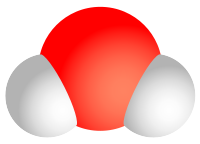
Water Molecule showing 1 Oxygen atom and 2 hydrogen atoms
Molecular Formula
There are only just over 100 types of atoms, but there are millions and millions of different types of substances out there. This is because they are all made up of different types of molecules. Molecules are not only made up of different types of atoms but also different ratios. Like in the water example above, a water molecule has 2 hydrogen atoms and 1 oxygen atom. This is written as H2O.
Other examples are carbon dioxide (C02), ammonia (NH3), and sugar or glucose (C6H12O6). Some formulas can get quite long and complex.
Let's look at the molecule for sugar:
C6 - 6 carbon atoms
H12 - 12 hydrogen atoms
O6 - 6 oxygen atom
It takes these specific atoms in these specific numbers to make up a sugar molecule.
Bonds
Molecules and compounds are held together by forces called chemical bonds. There are two main types of bonds that hold most compounds together: covalent bonds and ionic bonds. Some compounds can have both types of bonds.
Both main types of bonds involve electrons. Electrons orbit atoms in shells. These shells want to be "full" of electrons. When they aren't full, they will try to bond with other atoms to get the right amount of electrons to fill their shells.
Covalent Bonds - Covalent bonds share electrons between atoms. This happens when it works out for atoms to share their electrons in order to fill their outer shells.
Ionic Bonds - Ionic bonds form when one electron is donated to another. This happens when one atom gives up an electron to another in order to form a balance and, therefore, a molecule or compound.
Fun Facts about Molecules
- Oxygen gas normally is the molecule O2, but it can also be O3 which we call ozone.
- 66% of the mass of the human body is made up of oxygen atoms.
- Molecules can have different shapes. Some are long spirals while others may be pyramid shaped.
- Organic compounds are compounds that contain carbon.
- A perfect diamond is a single molecule made of carbon atoms.
- DNA is a super long molecule that has information uniquely describing every human being.
воскресенье, 29 апреля 2018 г.
Melting and Boiling
Melting and Boiling
As we learned in solids, liquids, and gases all matter exists in certain states or phases. Water can be liquid water, solid ice, or gas vapor. It's still all water, however, and made up of molecules of 2 hydrogen atoms and 1 oxygen atom (H2O).
Lava is melted or liquid rock
Melting and Freezing
When a solid turns into a liquid it is called melting. There is a temperature at which this happens called the melting point. As the energy in the molecules increases from a rise in temperature, the molecules start moving faster. Soon they have enough energy to break free of their rigid structure and start moving around more easily. The matter becomes a liquid. The melting point for water is 0 degrees C (32 degrees F).
When the opposite happens and a liquid turns into a solid, it is called freezing.
Boiling and Condensation
When a liquid becomes a gas it is called boiling or vaporization. Again, at a certain temperature called the boiling point, the molecules will gain enough energy to break free and become a gas. The boiling point for water is 100 degrees C (212 degrees F).

When the opposite occurs and a gas becomes a liquid, it is called condensation.
Evaporation is liquid becoming a gas that happens only on the surface of a liquid. Evaporation doesn't always need a high temperature to occur. Even though the overall energy and temperature of a liquid may be low, the molecules on the surface that are in contact with the air and gases around them, can be high energy. These molecules on the surface will slowly become gases through evaporation. You can see evaporation when water on your skin dries or a puddle in the street slowly goes away.
Standard State
Scientist use the term "standard state" to describe the state an element or substance is in at "room conditions" of 25 degrees C and one atmosphere of air pressure. Most of the elements, like gold and iron, are solids in their standard state. Only two elements are liquid in their standard states: mercury and bromine. Some of the elements that are gases in their natural state include hydrogen, oxygen, nitrogen, and the noble gases.
Fun facts about Melting and Boiling
- When rocks get really hot they turn into a liquid called magma or lava.
- Gas can be turned into a liquid through pressure. By squeezing all the gas molecules tightly together a gas can become liquid.
- We use natural gas in our homes in its gas state, but when it's shipped in ocean tankers it's shipped in a liquid state to save on space.
- Mercury has the interesting properties of being both a metal and a liquid in its standard state.
Pure Substances and Mixtures
Pure Substances and Mixtures
What is matter?
Matter can be defined as any substance that has inertia, occupies space and has mass.
How is matter classified?
Scientists of the world classify matter as solid, liquid or gas, but there is one more interesting way to classify it. Matter can also be classified as pure substances and mixtures.
What is a pure substance?
A pure substance is a type of matter which exists in its most basic or purest form and cannot be broken down further. Examples of pure substances include water, gases like carbon dioxide, oxygen and metals like platinum, gold and silver.
Each pure substance has its own set of unique chemical and physical properties which helps us in identifying it.
Examples of pure substances
Water has a freezing and melting point of 0°C and a boiling point of 100°C. It is colourless, tasteless and odourless.
Gold is considered pure at 24 karat. It is yellow in color, solid at room temperature and is regarded as a good conductor of electricity. It is also malleable and ductile in nature.
Gold is considered pure at 24 karat. It is yellow in color, solid at room temperature and is regarded as a good conductor of electricity. It is also malleable and ductile in nature.
Types of pure substances
Pure substances can be divided into two categories – elements and compounds.
Elements are made up of the same types of atoms. The known elements listed in the periodic table can be considered pure substances. Examples of elements include hydrogen, oxygen, gold, silver
Compounds are made up of different types of atoms joined together by chemical bonds. Examples of compounds include water, glucose, salt and carbon dioxide.
Elements are made up of the same types of atoms. The known elements listed in the periodic table can be considered pure substances. Examples of elements include hydrogen, oxygen, gold, silver
Compounds are made up of different types of atoms joined together by chemical bonds. Examples of compounds include water, glucose, salt and carbon dioxide.
What is a mixture?
Mixture is a combination of two or more pure substances where each substance keeps its own identity upon mixing. Mixtures are present almost everywhere on Earth. Look at rocks, the ocean, rivers or even the atmosphere. All of them are mixtures! In other words, anything that you can mix together is a mixture. Even the foods you eat.
Why is it called a mixture?
It means the fundamental chemical structure of the components in a mixture does not change upon mixing.
Examples of mixtures
Although water is a pure substance, if you put sand into a glass of water, it would turn into a mixture. Each of the components of a mixture can be separated from one another. You can always separate the sand from water by filtering it.
If you take a mixture of salt and water, you can separate it by evaporating the water, to get salt in the container. Air, too, is a mixture of different gases such as carbon dioxide, oxygen, nitrogen and water vapour etc. Blood is a mixture made up of different types of blood cells and plasma.
Types of mixtures
- Homogeneous mixture – The components of a homogeneous mixture have a uniform composition, and cannot be seen separately. The prefix ‘homo’ means same and it tells us that when two substances combine extremely well with one another, they form a uniform mixture. For example, sugar and water do not chemically react and form another compound although the water does turn sweet!
- Heterogeneous mixture – The components of a heterogeneous mixture do not have a uniform composition and can be viewed separately without losing their identity. For example, if you mix sulfur powder with iron dust, you can easily see the two separately. You can even separate the iron dust by using a magnet.
How do we differentiate between pure substances and mixtures?
- A Pure Substance is matter which cannot be separated into its basic components by using a physical or a chemical process. The physical and chemical properties of pure substances are non-changing, if it is on its own without disturbing.
- A Mixture is made up of a combination of two or more substances that are not united using a chemical reaction. The physical and chemical properties of mixtures vary.
вторник, 27 марта 2018 г.
Подписаться на:
Сообщения (Atom)