среда, 25 марта 2020 г.
Homework
1. Unit 5. Text "The periodic table of the chemical elements" on pages 31-32.(to translate);

Dmitri Mendeleev
Dmitri Mendeleev
Dmitri Mendeleev, Russian in full Dmitry Ivanovich Mendeleyev (1834-1907), Russian chemist who developed the periodic classification of the elements. Mendeleev found that, when all the known chemical elements were arranged in order of increasing atomic weight, the resulting table displayed a recurring pattern, or periodicity, of properties within groups of elements. In his version of the periodic table of 1871, he left gaps in places where he believed unknown elements would find their place. He even predicted the likely properties of three of the potential elements. The subsequent proof of many of his predictions within his lifetime brought fame to Mendeleev as the founder of the periodic law.
Mendeleev was born in the small Siberian town of Tobolsk . In1848 Dmitri enrolled in the Main Pedagogical Institute in St.Petersburg. Mendeleev graduated in 1855. He received a master’s degree in 1856 and began to conduct research in organic chemistry.
In 1861 Mendeleev returned to St. Petersburg, where he obtained a professorship at the Technological Institute in 1864. After the defense of his doctoral dissertation in 1865 he was appointed professor of chemical technology at the University of St. Petersburg (now St. Petersburg State University). He became professor of general chemistry in 1867 and continued to teach there until 1890.
As he began to teach inorganic chemistry, Mendeleev could not find a textbook that met his needs. Since he had already published a textbook on organic chemistry in 1861 that had been awarded the prestigious Demidov Prize, he set out to write another one. The result was Osnovy khimii (The Principles of Chemistry), which became a classic, running through many editions and many translations.
When Mendeleev began to compose the chapter on the halogen elements at the end of the first volume, he compared the properties of this group of elements to those of the group of alkali metals such as sodium. Within these two groups of dissimilar elements, he discovered similarities in the progression of atomic weights, and he wondered if other groups of elements exhibited similar properties. After studying the alkaline earths, Mendeleev established that the order of atomic weights could be used not only to arrange the elements within each group but also to arrange the groups themselves. Thus, in his effort to make sense of the extensive knowledge that already existed of the chemical and physical properties of the chemical elements and their compounds, Mendeleev discovered the periodic law.
His newly formulated law was announced before the Russian Chemical Society in March 1869 with the statement “elements arranged according to the value of their atomic weights present a clear periodicity of properties.” Mendeleev’s law allowed him to build up a systematic table of all the 70 elements then known. He had such faith in the validity of the periodic law that he proposed changes to the generally accepted values for the atomic weight of a few elements and predicted the locations within the table of unknown elements together with their properties. At first the periodic system did not raise interest among chemists. However, with the discovery of the predicted elements, notably gallium in 1875, scandium in 1879, and germanium in 1886, it began to win wide acceptance. Gradually the periodic law and table became the framework for a great part of chemical theory. By the time Mendeleev died in 1907, he enjoyed international recognition and had received distinctions and awards from many countries.
Mendeleev was born in the small Siberian town of Tobolsk . In1848 Dmitri enrolled in the Main Pedagogical Institute in St.Petersburg. Mendeleev graduated in 1855. He received a master’s degree in 1856 and began to conduct research in organic chemistry.
In 1861 Mendeleev returned to St. Petersburg, where he obtained a professorship at the Technological Institute in 1864. After the defense of his doctoral dissertation in 1865 he was appointed professor of chemical technology at the University of St. Petersburg (now St. Petersburg State University). He became professor of general chemistry in 1867 and continued to teach there until 1890.
As he began to teach inorganic chemistry, Mendeleev could not find a textbook that met his needs. Since he had already published a textbook on organic chemistry in 1861 that had been awarded the prestigious Demidov Prize, he set out to write another one. The result was Osnovy khimii (The Principles of Chemistry), which became a classic, running through many editions and many translations.
When Mendeleev began to compose the chapter on the halogen elements at the end of the first volume, he compared the properties of this group of elements to those of the group of alkali metals such as sodium. Within these two groups of dissimilar elements, he discovered similarities in the progression of atomic weights, and he wondered if other groups of elements exhibited similar properties. After studying the alkaline earths, Mendeleev established that the order of atomic weights could be used not only to arrange the elements within each group but also to arrange the groups themselves. Thus, in his effort to make sense of the extensive knowledge that already existed of the chemical and physical properties of the chemical elements and their compounds, Mendeleev discovered the periodic law.
His newly formulated law was announced before the Russian Chemical Society in March 1869 with the statement “elements arranged according to the value of their atomic weights present a clear periodicity of properties.” Mendeleev’s law allowed him to build up a systematic table of all the 70 elements then known. He had such faith in the validity of the periodic law that he proposed changes to the generally accepted values for the atomic weight of a few elements and predicted the locations within the table of unknown elements together with their properties. At first the periodic system did not raise interest among chemists. However, with the discovery of the predicted elements, notably gallium in 1875, scandium in 1879, and germanium in 1886, it began to win wide acceptance. Gradually the periodic law and table became the framework for a great part of chemical theory. By the time Mendeleev died in 1907, he enjoyed international recognition and had received distinctions and awards from many countries.
среда, 26 февраля 2020 г.
Elements in the Human Body
Six elements account for 99% of the mass of the human body. The acronym CHNOPS may be used to help remember the six key chemical elements that are used in biological molecules. C is carbon, H is hydrogen, N is nitrogen, O is oxygen, P is phosphorus, and S is sulfur. While the acronym is a good way to remember the identities of the elements, it doesn't reflect their abundance.
- Oxygen is the most abundant element in the human body accounting for approximately 65% of a person's mass. Each water molecule consists of two hydrogen atoms bonded to one oxygen atom, but the mass of each oxygen atom is much higher than the combined mass of the hydrogen. In addition to being a component of water, oxygen is essential for cellular respiration.
- Carbon is contained in all organic compounds, which is why carbon is the second most abundant element in the body, accounting for about 18% of body mass. Carbon is found in proteins, carbohydrates, lipids, and nucleic acids. It's also found in carbon dioxide.
- Hydrogen atoms are the most numerous type of atom in a human, but because they are so light, they only make up around 10% of the mass. Hydrogen is in water, plus it's an important electron carrier.
- Nitrogen is about 3.3% of body mass. It's found in proteins and nucleic acids.
- Calcium accounts for 1.5% of body mass. It's used to build bones and teeth, plus it's important for muscle contraction.
- Phosphorus is about 1% of body mass. This element is found in nucleic acids. Breaking bonds connecting phosphate molecules is a major component of energy transfer.
- Potassium is around 0.2-0.4% of the mass of a person. It's used in nerve conduction. Potassium is a key cation or positively-charged ion in the body.
- Sulfur is found in some amino acids and proteins. It's about 0.2-0.3% of body mass.
- Sodium, like potassium, is a positively-charged ion. It's about 0.1-0.2% of body mass. Sodium helps regulate the electrolyte balance in the body and maintain homeostasis with respect to the volume of water in the blood and cells.
- Although aluminum and silicon are abundant in the earth's crust, they are found in trace amounts in the human body.
- Other trace elements include metals, which are often cofactors for enzymes (e.g., cobalt for vitamin B12). Trace elements include iron, cobalt, zinc, iodine, selenium, and flourine.
Chemical Composition of the Human Body
Major Classes of Compounds in the Human Body
Most of the elements are found within compounds. Water and minerals are inorganic compounds. Organic compounds include fat, protein, carbohydrates, and nucleic acids.
- Water: Water is the most abundant chemical compound in living human cells, accounting for 65 percent to 90 percent of each cell. It's also present between cells. For example, blood and cerebrospinal fluid are mostly water.
- Fat: The percentage of fat varies from person to person, but even an obese person has more water than fat.
- Protein: In a lean male, the percentages of protein and water are comparable. It's about 16 percent by mass. Muscles, including the heart, contain a lot of muscle. Hair and fingernails are protein. Skin contains a large amount of protein, too.
- Minerals: Minerals account for about 6 percent of the body. They include saltsand metals. Common minerals include sodium, chlorine, calcium, potassium, and iron.
- Carbohydrates: Although humans use the sugar glucose as an energy source, there isn't that much of it free in the bloodstream at any given time. Sugar and other carbohydrates only account for about 1% of body mass.
:max_bytes(150000):strip_icc():format(webp)/human-body-infographics-465321784-57ab54755f9b58974a07fa9f.jpg)
среда, 18 декабря 2019 г.
Chemistry Lab Equipment
Chemistry Lab Equipment
| Beaker - A beaker is a glass container with a flat bottom and a small spout for pouring. It is used in the chemistry lab for mixing, heating, and stirring liquids. Beakers come in various sizes and are shaped like a cylinder. | 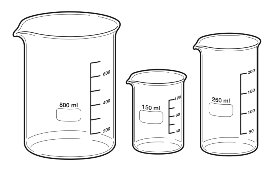 Beakers Beakers |
| Bunsen burner - The Bunsen burner is a metal tube that produces a flame from gas such as methane, propane, or butane. It is used in the lab for heating and sterilizing. The Bunsen burner is named after German chemist Robert Bunsen. |  Bunsen burner |
Crucible - Crucibles are containers used for heating substances to very high temperatures. They are generally made from materials such as porcelain, nickel, and alumina.
| Erlenmeyer flask - This is a type of chemistry flask with a conical shaped body, a cylindrically shaped neck, and a flat bottom. It generally has measurement marks on the side. It is similar to a beaker, but has the cone shaped body. The cone shape reduces losses from evaporation and helps to prevent spills when stirring the liquid. | 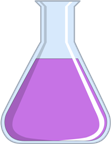 Erlenmeyer flask |
| Funnel - A funnel is a pipe with a wide mouth that helps to pour substances into a container without spilling. In a chemistry lab, funnels are often used together with filters to separate a mixture. |  Funnel and flask |
| Gloves - Laboratory gloves are important to wear in order to protect the skin from chemical substances. Always listen to your teacher and make sure to wear gloves when performing experiments. |  Always wear gloves |
| Goggles - Goggles are very important when performing experiments of any kind. They can keep dangerous chemicals and other substances from damaging your eyes. Always wear your goggles in the lab! |  Always wear goggles |
| Graduated cylinder - A tall skinny cylinder used to measure volumes. It is generally a more accurate way to measure volume than a typical beaker or flask. | 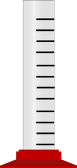 Graduated cylinder |
| Mortar and pestle - A mortar and pestle are used to crush and grind solids into a powder. The mortar is a bowl and the pestle is a small club-shaped tool. They are typically made from ceramic or stone. |  Mortar and pestle |
| Pipette - A narrow glass tube used to transfer liquids from one place to another. Pipettes sometimes are used for measurement. The accuracy of different pipettes varies widely. |  Pipette |
Scoopula - A scoopula is a metal spatula-type utensil used to scoop up solids such as powders in a chemistry lab.
Stirring rod - A skinny solid glass rod used in chemistry to mix chemicals and liquids. A stirring rod is typically about the length of a long straw and has rounded ends.
| Test tube - A test tube is a glass or plastic tube used for holding, mixing, and heating small quantities of liquid chemicals. Test tubes often have a flared top to help with pouring. They come in a variety of sizes. Test tube holder - A stand built for holding multiple test tubes. Test tube brush - A brush designed to help clean out test tubes. Test tube clamps - Clamps that hold test tubes while using them to heat up chemicals during a lab experiment. | 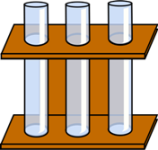 Test tubes in a holder |
Thermometer - A device used for measuring the temperature of a substance.
Triangle - A triangle made of clay pipes and wire that can withstand high temperatures. It is often used to hold a crucible.
Wire gauze - A wire gauze is used to support a beaker or flask when heating. The wire gauze helps to spread the heat evenly.
Organic Chemistry
Organic Chemistry
What is organic chemistry?
Organic chemistry is the study of compounds that contain the element carbon. This is a wide ranging topic that overlaps with other sciences like biochemistry, medicine, and materials science. Organic chemists study the properties, structure, and chemical reactions of organic compounds.
Why is carbon important?
Carbon is the central element to all living organisms. It is the basis to all life on earth. By studying carbon and organic compounds, scientists can learn more about life, the human body, and how it works.
Organic Molecules
Most organic molecules are made up of long rings or chains of carbon atoms with atoms of other elements attached. Common elements besides carbon (C) that are found in organic compounds include hydrogen (H), oxygen (O), nitrogen (N), phosphorus (P), and sulfur (S). Some examples of organic molecules include:
There are a number of types of organic compounds. Scientists divide these up into functional groups based on the type of element common to the group in addition to carbon. These groups have similar properties because they have similar molecules.
Hydrocarbons
Hydrocarbons form a functional group of organic compounds that are composed of only hydrogenand carbon atoms. Within the group of hydrocarbons are other groups such as alkanes. Alkanes include ethane, propane, methane, and butane. A lot of these compounds are used for heating and cooking. Other groups of hydrocarbons are alkenes, and alkynes.
Other elements
Other elements that carbon combines with to form organic compounds include oxygen, nitrogen, sulfur, phosphorus, and boron.
Organic Synthesis
Organic synthesis is the process of making organic compounds. Many of the products we use everyday are made from organic compounds produced in large factories. Examples of these include plastics, alcohols, rubber, and dyes.
What is the difference between organic chemistry and biochemistry?
We learned that organic chemistry is the study of compounds containing carbon. Biochemistry, on the other hand, is the study of chemical processes in biological systems. These two sciences often overlap as organic compounds play an important role in many chemical processes.
Interesting Facts about Organic Chemistry
What is organic chemistry?
Organic chemistry is the study of compounds that contain the element carbon. This is a wide ranging topic that overlaps with other sciences like biochemistry, medicine, and materials science. Organic chemists study the properties, structure, and chemical reactions of organic compounds.
Why is carbon important?
Carbon is the central element to all living organisms. It is the basis to all life on earth. By studying carbon and organic compounds, scientists can learn more about life, the human body, and how it works.
Organic Molecules
Most organic molecules are made up of long rings or chains of carbon atoms with atoms of other elements attached. Common elements besides carbon (C) that are found in organic compounds include hydrogen (H), oxygen (O), nitrogen (N), phosphorus (P), and sulfur (S). Some examples of organic molecules include:
- Carbohydrates - Carbohydrates consist only of carbon, hydrogen, and oxygen. They include starches and sugars and play an important role in our daily lives.
- Lipids - Lipids include fats and waxes. They are used for long term storage of energy in life forms.
- Proteins - Proteins are made up of long chains of amino acids. Proteins play an important role in nearly every process that takes place in cells.
- Nucleic Acids - Nucleic acids make up long chains of components such as DNA and RNA. DNA carries information such as genes for protein molecules to use. The RNA helps to move the DNA code from storage to where it can be used.
There are a number of types of organic compounds. Scientists divide these up into functional groups based on the type of element common to the group in addition to carbon. These groups have similar properties because they have similar molecules.
Hydrocarbons form a functional group of organic compounds that are composed of only hydrogenand carbon atoms. Within the group of hydrocarbons are other groups such as alkanes. Alkanes include ethane, propane, methane, and butane. A lot of these compounds are used for heating and cooking. Other groups of hydrocarbons are alkenes, and alkynes.
Other elements
Other elements that carbon combines with to form organic compounds include oxygen, nitrogen, sulfur, phosphorus, and boron.
Organic Synthesis
Organic synthesis is the process of making organic compounds. Many of the products we use everyday are made from organic compounds produced in large factories. Examples of these include plastics, alcohols, rubber, and dyes.
What is the difference between organic chemistry and biochemistry?
We learned that organic chemistry is the study of compounds containing carbon. Biochemistry, on the other hand, is the study of chemical processes in biological systems. These two sciences often overlap as organic compounds play an important role in many chemical processes.
Interesting Facts about Organic Chemistry
- Carbon occurs in its pure form in nature as graphite and diamond.
- Around 18 percent of the human body is carbon atoms.
- Charles Goodyear found that combining rubber with sulfur allowed the rubber to be more durable across temperatures.
- Synthetic dyes made from organic compounds have allowed the manufacture of dyes rather than using plants for dyes.
- DNA molecules are very long. If you stretched one out it would be about three feet long.
четверг, 28 ноября 2019 г.
Подписаться на:
Сообщения (Atom)