пятница, 17 ноября 2023 г.

What is aluminium?

 What is aluminium?

Aluminium is a silvery-white metal, the 13 element in the periodic table. One surprising fact about aluminium is that it's the most widespread metal on Earth, making up more than 8% of the Earth's core mass. It's also the third most common chemical element on our planet after oxygen and silicon.

At the same time, because it easily binds with other elements, pure aluminium does not occur in nature. This is the reason that people learned about it relatively recently. Formally aluminium was produced for the first time in 1824 and it took people another fifty years to learn to produce it on an industrial scale.

The most common form of aluminium found in nature is aluminium sulphates. These are minerals that combine two sulphuric acids: one based on an alkaline metal (lithium, sodium, potassium rubidium or caesium) and one based on a metal from the third group of the periodic table, primarily aluminium.

Aluminium sulphates are used to this day to clean water, for cooking, in medicine, in cosmetology, in the chemical industry and in other sectors. By the way, aluminium got its name from aluminium sulphates which in Latin were called alumen.

Today we know about almost 300 various aluminium compounds and minerals containing aluminium, from feldspar, a key source mineral on Earth, to ruby, sapphire and emerald, which are far less common.

But regardless of how common aluminium may be, it may have remained hidden forever if it hadn't been for electricity. The discovery of aluminium was made possible when scientists were able to use electricity to break down chemical compounds into their elements. In the 19 century the Danish physicist Christian Oersted used electrolysis to obtain aluminium. Electrolysis or electrolytic reduction is the process that is used to produce aluminium today as well.

Another rather common mineral, bauxite, is used today as the primary raw material in aluminium production. Bauxite is a clay mineral comprising various modifications of aluminium hydroxide mixed with iron, silicon, titanium, sulphur, gallium, chromium, vanadium oxides, as well as sulphuric calcium, iron and magnesium carbonates. In other words, your typical bauxite contains almost half the periodic table. By the way, because of the texture of bauxite about a hundred years ago aluminium was often referred to rather poetically as silver obtained from clay. On the average 4-5 tonnes of bauxite are needed to produce 1 tonne of aluminium.

In the first stage of aluminium production bauxite is processed into alumina, or aluminium oxide Al2O3. Alumina looks like white powder and it is then processed into aluminium at aluminium smelters using electrolytic reduction.

Aluminium production requires huge amounts of electricity, about 15 MWH per tonne of output. That's approximately as much as a 100-apartment block consumes in a month. So the best site for an aluminium smelter is next to a powerful, preferably renewable, energy source. Hydroelectric power plants are the best option as they are the most powerful 'green' energy sources available today.

Aluminium offers a rare combination of valuable properties. It is one of the lightest metals in the world: it's almost three times lighter than iron but it's also very strong, extremely flexible and corrosion resistant because its surface is always covered in an extremely thin and yet very strong layer of oxide film. It doesn't magnetise, it's a great electricity conductor and forms alloys with practically all other metals.

Since aluminium easily forms compounds with other chemical elements, a huge variety of aluminium alloys have been developed. Even a very small amount of admixtures can drastically change the properties of the metal, making it possible to use it in new areas. For example, in ordinary life you can find aluminium mixed with silicon and magnesium literally on the road, i.e. in the aluminium alloy wheels, in the engines, chassis and other parts of modern automobiles. As for aluminium zinc alloy, chances are you might be holding it in your hands right now as it's this alloy that's widely used in the production of mobile phones and tablet PCs. In the meantime, scientists keep developing new aluminium alloys.

The modern construction, automotive, aviation, energy, food and other industries would be impossible without aluminium. In addition, aluminium has become a symbol of progress: all cutting edge devices and vehicles are made from aluminium. 

What Is the Most Conductive Element?

 What Is the Most Conductive Element?

Conductivity is a material’s ability to transmit energy. Because there are different forms of energy, there are different types of conductivity, including electrical, thermal, and acoustic conductivity. Silver is the most conductive element, in terms of electrical conductivity. Carbon in the form of diamond is the best thermal conductor (silver is the best metal). After silver, copper is the next best conductor, followed by gold. In general, metals are the best thermal and electrical conductors.

Why Is Silver the Best Conductor?

The reason silver is the best electrical conductor is because its electrons are freer to move than those of other elements. This has to do with silver’s crystal structure and electron configuration. Although silver is the best electrical conductor, it readily tarnishes and loses conductivity, plus it is more expensive than copper. Gold is used when corrosion resistance is important.

Here is a table of the electrical conductivity of the ten most conductive elements. All of these elements are metals. Many alloys are also conductive, including carbon steel, stainless steel, brass, bronze, Galinstan, and Manganin. Nonmetals are electrical insulators, with a few exceptions.

Electrical Conductivity of the Elements

Most conductive elements:

Silver

Copper

Gold

Aluminum

Calcium

Tungsten

Zinc

Cobalt

Nickel

Ruthenium

Thermal Conductivity of the Elements

Here is a table of thermal conductivity of the elements. Most tables only list metals, because metals in general conduct heat better than nonmetals. Diamond (a nonmetal) is an exception.

Diamond (carbon)

Silver

Copper

Gold

Aluminum

Beryllium

Calcium

Tungsten

Magnesium

Rhodium

Silicon

вторник, 17 октября 2023 г.

Fluorine

 Fluorine

The element fluorine

<---Oxygen       Neon--->
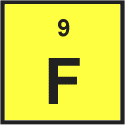
  • Symbol: F
  • Atomic Number: 9
  • Atomic Weight: 18.998
  • Classification: Halogen
  • Phase at Room Temperature: Gas
  • Density: 1.696 g/L @ 0°C
  • Melting Point: -219.62°C, -363.32°F
  • Boiling Point: -188.12°C, -306.62°F
  • Discovered by: Henri Moissan in 1886


Fluorine is the first element in the group of halogens which occupies the 17th column of the periodic table. Fluorine atoms have 9 electrons and 9 protons. It is a fairly rare element in the universe, but is the thirteenth most common element in the Earth's crust.

Characteristics and Properties

Fluorine's most notable characteristic is that it is the most reactive of all the elements. This makes it dangerous and difficult to handle. It will react with nearly every other element. It is also the most electronegative of the elements, meaning that it attracts electrons towards itself.

In standard conditions fluorine forms a gas made up of two fluorine atoms called a diatomic gas. It is pale greenish-yellow in color with a pungent odor.

Fluorine is toxic for humans and very corrosive. Many of the reactions with fluorine are sudden and explosive. Fluorine will burn all sorts of compounds and elements including water, copper, gold, and steel.

Where is fluorine found on Earth?

Because it is so reactive, fluorine does not occur as a free element in nature. It is readily found in minerals in the Earth's crust including fluorspar, fluorapatite, and cryolite. The main source of commercial fluorine is fluorspar (which is also called fluorite). The majority of the world's fluorspar is supplied by China and Mexico.

How is fluorine used today?

Fluorine is rarely used in its pure form, but many compounds of fluorine are used by industry.

One of the most popular applications of fluorine is for refrigerant gases. For many years Chlorofluorocarbons (CFCs) were used for freezers and air conditioners. Today they have been banned because they damage the ozone layer. Many of the replacement gases still contain fluorine, however.

Another application is fluoride. Fluoride is a reduced form of fluorine when bonded to another element. Fluoride is helpful in preventing tooth decay and is used in tap water and toothpaste.

Other applications that use fluorine include high temperature plastics such as Teflon, the smelting of iron and metal production, pharmaceuticals, etching glass, and in processing nuclear fuel.

How was it discovered?

Although other chemists had suspected the presence of an unknown element in the compound fluoric acid, it was French chemist Henri Moissan who first successfully isolated the element in 1886.

Where did fluorine get its name?

The name fluorine is derived from the mineral fluorite which comes from the Latin word "fluere" meaning "to flow." The name was suggested by English chemist Sir Humphry Davy.

Isotopes

Fluorine has one stable isotope, fluorine-19. It is the only form that fluorine occurs in naturally.

Interesting Facts about Fluorine
  • Hydrofluoric acid is extremely dangerous and can be fatal.
  • Henri Moissan was awarded the Nobel Prize in 1906 for his discovery.
  • It is found in the gemstone topaz.
  • CFCs were once used as propellant in aerosol spray cans.
  • The bond formed between carbon and fluorine to make fluorocarbons is the strongest bond in organic chemistry and is very stable.
  • Cesium is sometimes called fluorine's opposite element because it is the least electronegative element.

Chlorine

 Chlorine

The element chlorine

<---Sulfur       Argon--->
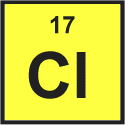
  • Symbol: Cl
  • Atomic Number: 17
  • Atomic Weight: 35.45
  • Classification: Halogen
  • Phase at Room Temperature: Gas
  • Density: 3.2 g/L @ 0°C
  • Melting Point: -101.5°C, -150.7°F
  • Boiling Point: -34.04°C, -29.27°F
  • Discovered by: Carl Wilhelm Scheele produced the gas in 1774, but it was Sir Humphry Davy who first called it an element and named it chlorine in 1810
Chlorine is the second element in the seventeenth column of the periodic table. It is classified as a member of the halogen group. It has 17 electrons and 17 protons with 7 valence electrons in the outer shell. It is about the twentieth most abundant element in the Earth's crust.

Characteristics and Properties

Under standard conditions chlorine is a gas that forms diatomic molecules. This means that two chlorine atoms join together to form Cl2. Chlorine gas is greenish yellow, has a very strong odor (it smells like bleach), and is poisonous to humans. High concentrations of chlorine gas can be fatal.

Chlorine is very reactive and, as a result, is not found in its free form in nature, but only in compounds with other elements. It will dissolve in water, but will also react with water as it dissolves. Chlorine will react with all the other elements except the noble gases.

Most common chlorine compounds are called chlorides, but it also forms compounds with oxygen called chlorine oxides.

Where is chlorine found on Earth?

Chlorine can be found in abundance in both the Earth's crust and in ocean water. In the ocean, chlorine is found as part of the compound sodium chloride (NaCl), also known as table salt. In the Earth's crust, the most common minerals containing chlorine include halite (NaCl), carnallite, and sylvite (KCl).

How is chlorine used today?

Chlorine is one of the most important chemicals used by industry. Tens of billions of pounds of chlorine are produced each year in the United States alone for use in industrial applications. It is used in making a variety of products including insecticides, pharmaceuticals, cleaning products, textiles, and plastics.

You have probably heard people mention that chlorine is used in pools. Chlorine is used in pools to keep it clean and safe by killing bacteria, germs, and algae. It is also used in drinking water to kill bacteria so we don't get sick when we drink it. Because it kills germs, chlorine is also used in disinfectants and is the basis for most bleaches.

Chlorine is needed for the survival of animal life in the form of table salt (NaCl). Our body's use it to help us digest food, move our muscles, and fight off germs.

How was it discovered?

Chlorine gas was first produced by Swedish chemist Carl Wilhelm Scheele in 1774. However, for many years scientists thought that the gas contained oxygen. It was English chemist Sir Humphry Davy who proved that it was a unique element in 1810. He also gave the element its name.

Where did chlorine get its name?

Chlorine gets its name from the Greek word "chloros", which means "yellow-green."

Isotopes

Chlorine has two stable isotopes: Cl-35 and Cl-37. Chlorine found in nature is a mixture of these two isotopes.

Interesting Facts about Chlorine
  • Chlorine gas was used by the Germans in WWI to poison the Allied soldiers.
  • Around 1.9% of the ocean's mass is composed of chlorine atoms.
  • It has a high density for a gas of 3.21 grams per liter (air is around 1.29 grams per liter).
  • Chlorine is used to make chlorofluorocarbons or CFCs. CFCs were once widely used in air conditioners and spray cans. Unfortunately, they contributed to destroying the ozone layer and have been mostly banned.
  • Most chlorine gas for industry is produced by using electrolysis on water that contains dissolved sodium chloride (salt water).

Iodine

 Iodine

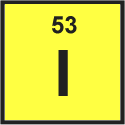
  • Symbol: I
  • Atomic Number: 53
  • Atomic Weight: 126.904
  • Classification: Halogen
  • Phase at Room Temperature: Solid
  • Density: 4.933 grams per cm cubed
  • Melting Point: 113.7°C, 236.66°F
  • Boiling Point: 184.3°C, 363.7°F
  • Discovered by: Bernard Courtois in 1811
Iodine is the fourth element in the seventeenth column of the periodic table. It is classified as a halogen and a non-metal. Iodine atoms have 53 electrons and 53 protons with 7 valence electrons in the outer shell.

Characteristics and Properties

Under standard conditions iodine is a dark blue-black solid. Iodine crystals can sublimate directly from a solid to a gas. As a gas, iodine is a purple vapor.

Iodine is a fairly active element, but is somewhat less active than the other halogens above it in the periodic table which include bromine, chlorine, and fluorine. Iodine can form compounds with many elements. Some of its most common compounds are formed with sodium and potassium.

Pure iodine can be dangerous to handle causing the skin to burn and damage to the eyes.

Where is it found on Earth?

Iodine is fairly rare, but is found in both the Earth's crust and in ocean water. There is actually a higher concentration of iodine in the ocean than in the Earth's crust. Some ocean plants such as seaweed have a high concentration of iodine. It is also found in underground brines near oil and natural gas reserves.

How is iodine used today?

Iodine has a number of uses. It is used in sanitation systems and as an antiseptic to kill germs and bacteria. It is also used in its radioactive form to enable doctors to diagnose medical issues and diseases.

Other applications include animal feed, cloud seeding, dyes, and photography.

Iodine is also an essential element for life. It plays an important role in the thyroid gland that controls the body's growth rate. Too little iodine can cause a person to have stunted growth and slower cognitive development (less intelligent). To make sure that people get enough iodine, it is often added to salt in what is called iodized salt.

How was it discovered?

Iodine was first discovered and isolated by French chemist Bernard Courtois in 1811. Courtois stumbled across iodine when running experiments on seaweed. It was French chemist Gay-Lussac who first named iodine as a new element and suggested the name.

Where did iodine get its name?

Iodine gets its name from the Greek word "iodes" which means "violet."

Isotopes

Iodine has one stable isotope that occurs naturally, iodine-127.

Interesting Facts about Iodine
  • Many people get the iodine they need in their diets from eating seaweed.
  • It is the heaviest element that is essential for human life and health.
  • Foods rich in iodine include fish, diary products (milk, cheese, yogurt), some fruits and vegetables, and iodized salt.
  • Pregnant women need more iodine than the average person. They can get this through dietary supplements.
  • Too much iodine is harmful and can make a person very sick. Never take iodine unless instructed by a doctor.

среда, 20 сентября 2023 г.

Is the Ozone Layer Finally Healing Itself?


Is the Ozone Layer Finally Healing Itself?

Earth is currently experiencing a host of environmental problems. Air and water pollution continue to plague much of the world; exotic plants, animals, and other organisms pop up in parts of the globe that have no natural defense against them; and, all the while, climate change lingers in the headlines. It’s often difficult to find good environmental news, but environmentalists and scientists have reported one bright spot: the countries of the world rallying to combat the problem of ozone depletion.

Earth’s protective ozone layer sits some 15 to 35 km [9 to 22 miles] above Earth’s surface, in the stratosphere. Stratospheric ozone loss is worrisome because the ozone layer effectively blocks certain types of ultraviolet (UV) radiation and other forms of radiation that could injure or kill most living things. For 30 years countries around the world had worked together to reduce and eliminate the use of chlorofluorocarbons (CFCs) and other ozone-destroying chemicals (ODCs). However, scientists still could not say whether these efforts were helping. Was the ozone layer actually healing itself?

Before getting to the answer, it helps to have some background on the problem. In 1974 American chemists Mario Molina and F. Sherwood Rowland and Dutch chemist Paul Crutzen discovered that human-produced CFCs could be a major source of chlorine in the stratosphere. They also noted that chlorine could destroy extensive amounts of ozone after it was liberated from CFCs by UV radiation. Since then, scientists have tracked how the ozone layer has responded to CFCs, which, since their creation in 1928 had been used as refrigerants, cleaners, and propellants in hairsprays, spray paint, and aerosol containers. In 1985 a paper by the British Antarctic Survey revealed that stratospheric ozone concentrations over Antarctica had been dropping precipitously (by more than 60% compared with global averages) since the late 1970s. Throughout the 1980s and early 1990s, observations and measurements from satellites and other instruments showed that this “hole” over Antarctica was growing larger year after year, that a similar hole had opened over the Arctic, and that stratospheric ozone coverage worldwide had dropped 5% between 1970 and the mid-1990s, with little change afterward.

In response to the growing problem, much of the world came together in 1987 to sign the Montreal Protocol on Substances That Deplete the Ozone Layer, an agreement that allowed the world to begin to phase out the manufacturing and use of CFCs—molecules containing only carbon, fluorine, and chlorine atoms—and other ODCs. Follow-up meetings throughout the 1990s and early 2000s produced amendments aimed at limiting, reducing, and eliminating hydrobromofluorocarbons (HBFCs), methyl bromide, carbon tetrachloride, trichloroethane, hydrofluorocarbons (HFCs), hydrochlorofluorocarbons (HCFCs), and other ODCs. Even though nearly all of the planet’s governments had been working diligently toward a common goal—good news in itself—it was unclear whether these unprecedented efforts were having much of an effect.

In 2014, however, scientists received the first bit of good news on this topic: the first small increases in stratospheric ozone in more than 20 years had been detected, along with evidence that ODCs had declined by 10–15% in the atmosphere. Yet they remained cautious. Some two years later, scientists got sufficient data to confidently reveal proof that the ozone layer was indeed on a path to recovery. The 2016 study, which tracked the evolution of the size of the ozone hole over Antarctica, observed that stratospheric ozone concentrations were continuing to increase and that the size of the Antarctic ozone hole had declined by half the size of the continental U.S. between 2000 and 2015. They expected the ozone layer to fully heal sometime between 2040 and 2070.

In 2023, a United Nations study brought these estimates into further focus. It found that if countries continued to adhere to the limits imposed by the Montreal Protocol and its follow-on agreements, the world could expect that ozone concentrations would largely return to their pre-1980 levels by 2040, with the Arctic reaching pre-1980 levels by 2045 and the Antarctic following suit by 2066.


среда, 13 сентября 2023 г.

Carbon footprint

 Carbon footprint

The carbon footprint shows how much carbon dioxide and other greenhouse gases a person produces in everyday life.  It measures the amount of fossil fuels and electricity someone uses up as well as the carbon footprint of the products they buy.


When we use our cars or heat our homes with 
oil or natural gas, carbon dioxide and various other gases are set free.  These emissions lead to a denser atmosphere and global warming.

You can measure your carbon footprint by using a calculator that you can find on various websites. It shows you in which way your living habits damage the environment. The carbon footprint usually measured in tons of CO2 per year. In America for example, every citizen produces about 28 tons of carbon dioxide and other dangerous gases a year, in Great Britain the amount is about 10 tons.

 How to reduce your carbon footprint

There are many actions you can take to reduce your carbon footprint.

The way we travel, for example, has a major impact on our environment. Use your bike or walk for short distances. Public transport is a way of getting to places without putting a burden on the environment. If you use your car see to it that it is maintained correctly and that it does not burn more fuel than it should.

Buying local food is also a way of curbing emissions into the atmosphere. Many environmental experts, however, argue that it often saves energy to buy food that is produced naturally in faraway places than consuming food grown locally in greenhouses.

In your home you can contribute to saving energy by turning off lights if you don’t need them or by avoiding the use of air conditioners, which contribute a lot to global warming and emit CFCs that destroy the ozone layer. Electrical appliances can save energy if you set them to standby mode.

Recycling plastic, glass and paper can also reduce your carbon footprint drastically.

It is also vital to persuade others to take the same steps that you do. Only if we concentrate on reducing carbon emissions together can we hope to make our environment better.