Relationship Between Chemistry and Other Branches of Science
‘Science’ can be defined as the systematic study of the natural universe, its structure, and everything it encompasses. Due to the immensity of the natural universe, science has been divided into several disciplines that deal with certain aspects of the universe. The three primary subcategories of science under which these disciplines can be grouped are:
- The Formal Sciences: Involves the study of the language disciplines that concern formal systems. Examples of scientific disciplines that fall under this category include logic and mathematics. Can be thought of as the “language of science”.
- The Natural Sciences: Involves the study of natural phenomena through experiments and observations. Chemistry, physics, and biology fall under this category of science.
- The Social Sciences: Involves the study of human societies and the relationships between the humans that dwell in these societies. Examples of scientific disciplines that fall under this category include psychology, sociology, and economics.
When the relationships between the major branches of science are considered, chemistry is found to lie close to the centre (as illustrated below).
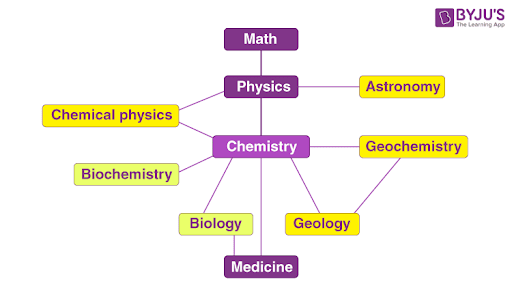
Thus, chemistry can be viewed as a central science whose roots bore into several other subdisciplines of science.
Branches of Chemistry
The five primary branches of chemistry are physical chemistry, organic chemistry, inorganic chemistry, analytical chemistry, and biochemistry. Follow the buttons provided below to learn more about each individual branch.


Apart from these primary branches, there exist several specialized fields of chemistry that deal with cross-disciplinary matters. Some such examples include medicinal chemistry, neurochemistry, materials chemistry, nuclear chemistry, environmental chemistry, polymer chemistry, and thermochemistry.

Комментариев нет:
Отправить комментарий