Frequently Asked Questions on Chemistry
What Is the Periodic Table?
The periodic table of chemical elements, often called the periodic table, organizes all discovered chemical elements in rows (called periods) and columns (called groups) according to increasing atomic number. In 1869, Russian chemist Dmitri Mendeleev created the framework that became the modern periodic table, leaving gaps for elements that were yet to be discovered.
“Sulphuric acid” is called the king of acids and “Nitric acid” is called the Queen of acids.
What are the 3 laws of gas?
Boyle’s Law tells us that the volume of gas increases as the pressure decreases. Charles’ Law tells us that the volume of gas increases as the temperature increases. And Avogadro’s Law tell us that the volume of gas increases as the amount of gas increases.
“Sulphuric acid” is called the king of acids and “Nitric acid” is called the Queen of acids.
What is a chemical change? Is cooking an egg a chemical change?
There are changes all around us like sugar dissolves in water, the lake freezes in winter etc. Some changes are what scientists call chemical changes and some are not. A chemical change takes place when new substances are made that are different from the substances that we started with.
Yes Cooking eggs, for instance, is an example of a chemical change; the egg white and egg yolk change from liquid to solid. The heat makes the proteins in the egg hardens.
Which acid is called “Kingly Water” and why?
Aqua Regia is the King’s Water, this is because it is strong enough to dissolve gold – the king of metals. It is prepared by mixing three parts of hydrochloric acid with one part nitric acid but in olden days it is prepared to mix and distill salts. For example, we can mix two parts niter with one part Sal. Ammoniac and distill at a high temperature to form Aqua Regia.
“Sulphuric acid” is called the king of acids and “Nitric acid” is called the Queen of acids.
What are the main branches of chemistry?
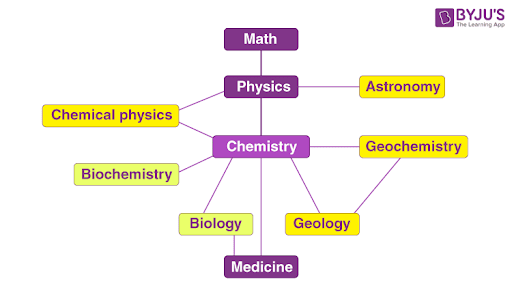
Chemistry is the science that studies atoms and molecules along with their properties. All matter is composed of atoms and molecules. There are 5 main branches of chemistry are
- Organic chemistry
- Inorganic chemistry
- Physical chemistry
- Biochemistry
- Analytical chemistry
What is the importance of organic chemistry?
Organic chemistry is simply the study of carbon compounds. Organic chemistry is important because it is life studies and all life-related chemical reactions. Organic chemistry initially involves the study of compounds that could be obtained from living organisms.
Approximately 7 million different organic compounds are known present while there are only 1.5 million known inorganic compounds. This large number of organic compounds arise from the unique property of carbon.
Which compound is known as “Blue Vitriol”?
Blue vitriol is also known as blue copperas. The word blue vitriol has a strict and definite meaning. It means sulphate of copper with the chemical formula CuSO4.5H2O. The chemical name for blue vitriol is Copper (II) Sulphate Pentahydrate. This salt occurs in the form of rhomboidal prisms of a deep blue colour, having an exceedingly harsh and styptic taste.
Similarly, “Green Vitriol” refers to Ferrous Sulphate.